
🧭 Overview
Color: 🔵
Competitiveness: 🔥🔥🔥🔥
Difficulty: 🧠🧠🧠🧠
Type: 🏹
Tempo: 🦅
🎯 Strategy
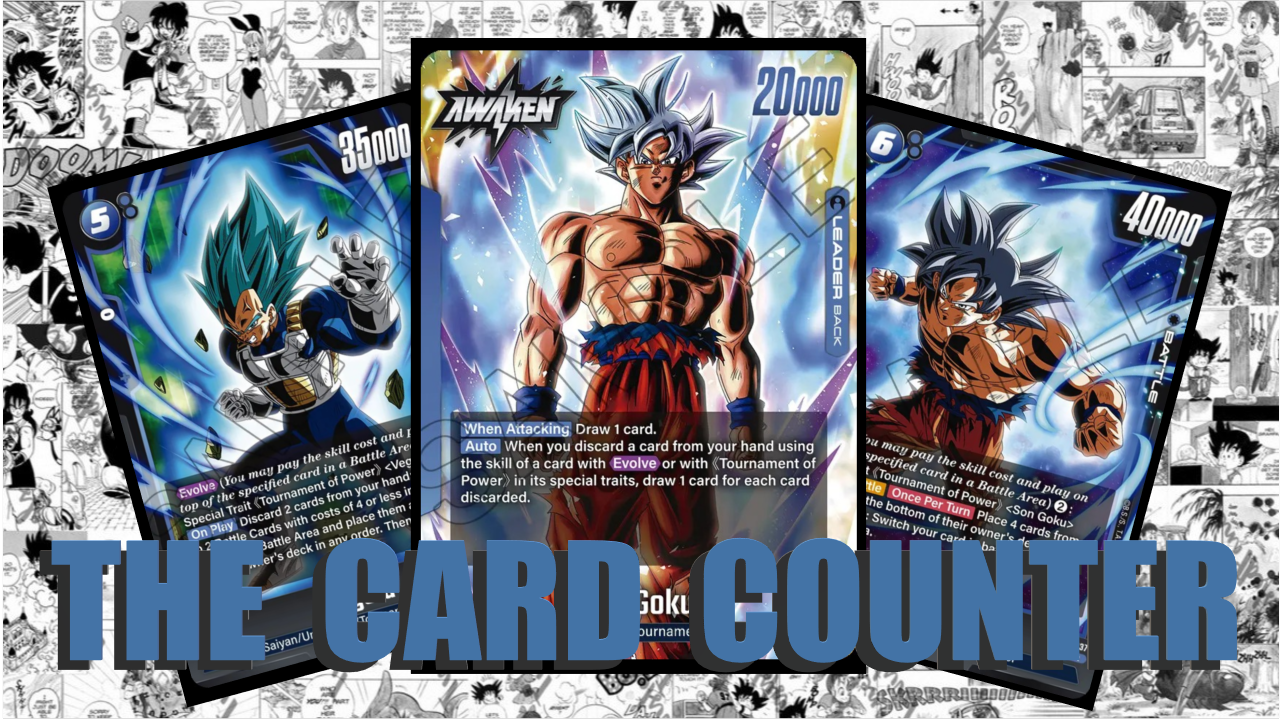
Our entire strategy is built on the Leader's ability, which allows us to draw a card after every archetype card we discard. This enables us to cycle through our entire deck systematically. However, this archetype synergy is limited. We only draw after discarding specific archetype cards, and only those count toward awakening. This is critical because we share the same awakening condition as Omega Shenron: we need 7 cards in the drop and must be at 6 life or less. Reaching 7 cards in the drop is more complicated here because we are forced to sacrifice cards from our hand early on. Consequently, the first two turns are strictly dedicated to fulfilling this condition, with Great Priest, Frieza, and Vegeta as our primary helpers.
After awakening, there is a very specific sequence we want to follow. At 3 energy, we want to play Vegeta, who provides board control, a card draw, and functions as a 35k attacker. At 4 energy, the best play is Goku, who assists in both offense and defense.
In the current fast meta, turn 5 is potentially nearing the endgame. If playing against a slower opponent, you can repeat the Goku play or even close the game with Kefla. If board management is required, Zeno and Vegeta are your primary tools, but always try to maximize your spent energy.
Victory depends on how effectively you rotate your cards, whether the right cards return to your hand when needed, and how well you utilize the potential of your extra cards.
⚠️ Challenges
This is not a deck where you can fire off the strongest effects turn after turn. Since Zeno consumes 12 cards from your drop, you can't realistically expect to activate him more than twice per match. While Goku consumes less, he has no protection, and in the current meta, 6-cost cards tend to evaporate almost for free during the opponent's turn.
Furthermore, running out of cards in hand is essentially a death sentence. You need a minimum of 2 cards in hand to do anything, and in Vegeta's case, you need two other cards. This requires a very difficult balance, as we already manage fewer resources than other decks because our hand burns until awakening.
🧱 Core Cards
FB09-037 Goku – The poster boy of the deck, offers two large attacks per turn and can negate an attack during the defense step.
FB09-045 Vegeta – The other critically important card and your main method of board control.
FB09-031 Zeno – Provides board control and prevents us from decking out.
💡 Tips
The 5c Vegeta can be played on top of another copy, essentially doubling his ability for 1 energy.
If your opponent has a way to remove the big Goku, activate his ability immediately so he can protect you from at least one attack.
⚙️ Fine-Tuning
Additional Cards
Tournament of Power
FB09-036 Goku: Can come down for 3 energy and draws a card every turn he stays up, however, he doesn't impact the board directly.
FB09-027 Kefla: For 5 energy, attacks twice with 30k, a budget Goku alternative but with 10k combo power.
FB08-029 Cabba: Alternative removal that doesn't require the drop but pulls from life.
Tech Cards
FB02-068 Absolute Lightning: Using non-archetype cards can be problematic for the engine, but this is a useful tool for removing 7+ cost units.
Ratio Adjustments
FB09-028 Android 17: Very matchup-dependent. Against many colors, it is impossible to activate his ability, so adjust the count according to preference.
FB08-046 Renso: The number of copies depends on how many other 1-cost cards fit in the deck.
📈 Meta
FP-071 Frieza: Useful for removing key 2-cost cards in the early game.
🎥 Gameplay
Digital
FB09
Ranked
886706f2-194c-45d7-9188-0d4bc9497196 - brogeta; master (youtube)
635501dd-bfff-4582-81f7-0307d87006b5 - kiogeta; master (youtube)
1e306b0f-38bf-4bc2-91ae-edf2f29f3826 - switchogeta; god (youtube)
d18da15e-0f5a-4134-a339-fa802a54c021 - muiku; god (youtube)
1e4e9fa5-db57-4dfa-9906-8d393b5aad5f - muiku; master
25339843-4d76-4d56-98e8-48ea2d3839c6 - muiku; platinum
9e66d4b8-ba67-4717-909e-fe18a256f04e - vegito; god (youtube)
Youtube
📃 List
💬 Personal Notes
Muiku was my #1 most anticipated leader before release. It looked like a competitive big brain blue deck, which I love. I still like it, but the deck is completely different from what I imagined. My initial build aimed for almost decking out but never actually doing so, I tried things like 6c Vegito, 4c Tien, and other fun cards. Eventually, I realized the deck is much more archetype-locked and linear than I first thought, and it wasn't the control deck I wanted. It's more of a midrange deck. In fact, it has a very rigid optimal curve regarding what and when to play to stay competent.
In that regard, I liked it less, but my main issue was that while it is a big brain deck, it's not the kind I prefer. I like decks where I have to read the opponent's mind, choose the best option among many, and use tactics to win. Muiku isn't that. It’s about card counting and long-term planning. A good Muiku player is one who makes the right decisions about what to recycle into the deck and calculates exactly when they will see those cards again, because at some point, they will. I am not that kind of player.
🔑 Legend
Icons
Type: 🗡️ Aggro | 🏹 Midrange | 🛡️ Control | 🔗 Combo
Tempo: 🐌 Slow | 🐇 Medium | 🦅 Fast
Difficulty
🧠: Beginner-friendly, perfect even for your first game.
🧠🧠: Easy; requires attention to a few small details, but follows a simple and clean strategy.
🧠🧠🧠: Requires learning, but becomes routine after sufficient practice.
🧠🧠🧠🧠: Requires a deep knowledge of both your own deck and the opponent's; demands situation-dependent decision-making.
🧠🧠🧠🧠🧠: Demands perfect play in both decision-making and execution through complex sequences.
Competitiveness
🔥: Unplayable; does not perform under any circumstances.
🔥🔥: Underperforms; highly dependent on favorable circumstances.
🔥🔥🔥: Performs well; perfect for casual play, but at a clear disadvantage against dominant decks.
🔥🔥🔥🔥: Suitable for competitive play; in theory, a skilled player can hold their own against anything.
🔥🔥🔥🔥🔥: Dominant; a typical "boogeyman" deck that everyone hates to face.
Glossary
Aggro: A strategy that ignores the opponent's game plan with the goal of ending the match as quickly as possible, in this case through relentless attacks.
Midrange: A strategy that seeks a middle ground, attempting to balance the tempo. It tries to slow down fast decks and outpace slow decks. Board control is a vital tool here.
Control: A strategy entirely focused on neutralizing the opponent's plays. It settles in for a long, slow game where the goal is to bleed the opponent out of resources.
Combo: A strategy that aims to win (or at least cause a radical shift in the game state) through the synergy of specific cards, often appearing to come out of nowhere. The goal is to gather the necessary components and fulfill the prerequisites as quickly as possible.